Beats built from morphology, not clips
Every complex is synthesised from P-wave, QRS and T-wave templates. Rate, regularity and morphology are continuous parameters, not a library of pre-recorded loops.
SimRhythm is a high-fidelity ECG and defibrillator simulator for medical training. It turns an iPad into a patient monitor students can train on. Learners can explore different rhythms, practise shocks and pacing, and see the simulated patient respond.
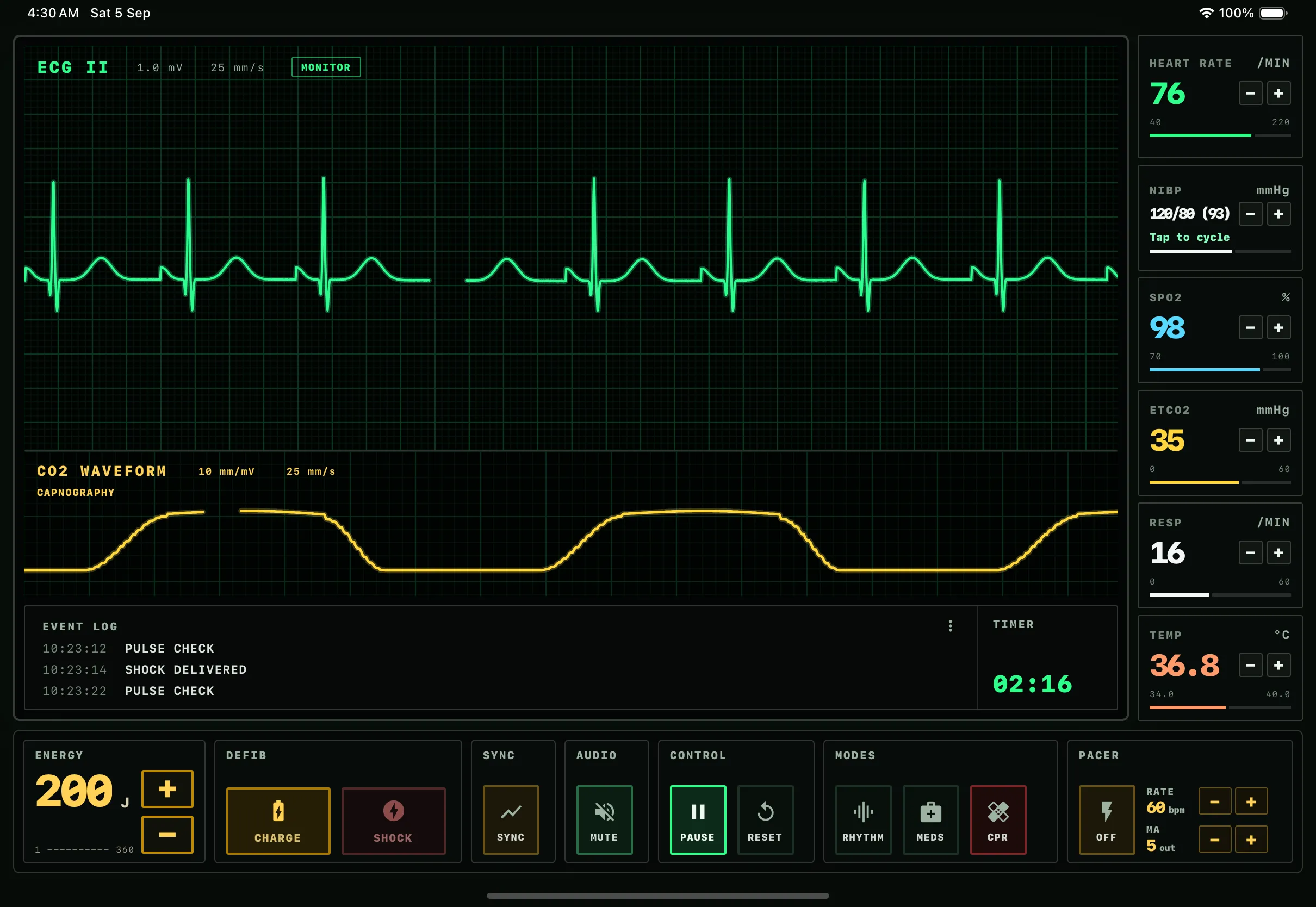
SimRhythm in MONITOR mode: lead II with capnography and live vitals.
Recognising a rhythm is only part of the lesson. Students also need to practise choosing an intervention and seeing what happens next.
Students need repetition: to see ventricular fibrillation degrade, shock it, and watch whether what they did worked. That means a monitor that behaves like the real thing, on an accessible tablet interface, with adjustable waveforms an instructor can use to explore different scenarios.
Every complex is synthesised from P-wave, QRS and T-wave templates. Rate, regularity and morphology are continuous parameters, not a library of pre-recorded loops.
A custom canvas renderer sweeps the trace in real time, the way a real monitor does. The renderer is designed for responsive simulation on an iPad.
Charge, shock, sync-cardiovert or pace, and the rhythm responds. The learner is trying to change the monitor, and it reacts to what they do.
Capnography, SpO₂, NIBP, respiration and temperature move together and stay physiologically plausible, so the picture reads as one patient.
The interface and simulation engine were developed together. Adjusting a rhythm, delivering a shock, and watching the response are connected parts of the experience, giving instructors a flexible setting for repeatable practice.